


BLOG
How to Sell Surplus Surgical Equipment (and Clear Out Your Storage Room)

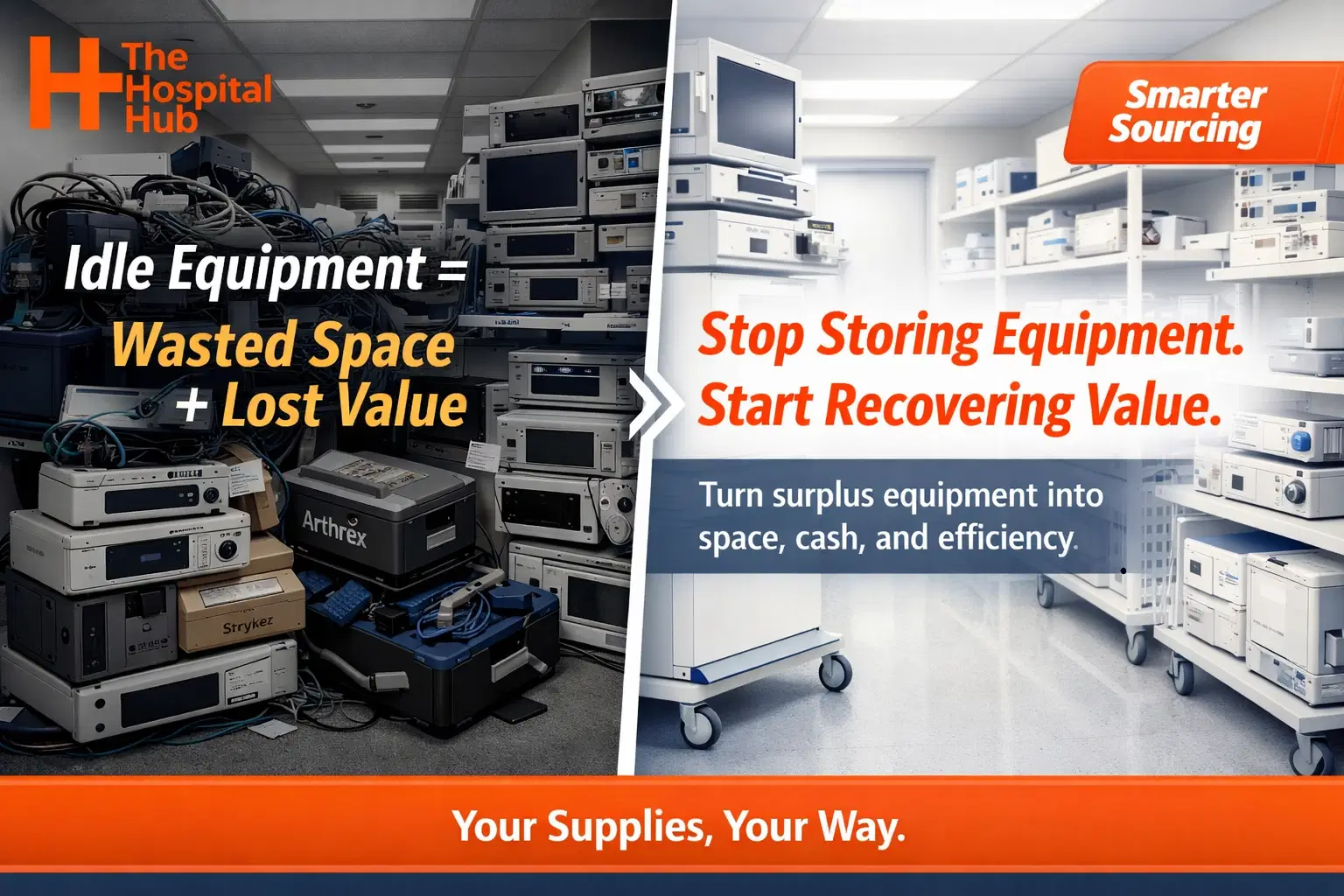
Looking to sell surplus medical equipment your hospital or surgery center no longer uses? You may be sitting on more value — and taking up more space — than you realize.
Let’s be honest: when you signed up for a career in materials management or healthcare supply chain, you probably didn’t realize professional Tetris player was going to be part of the job description.
Yet somehow, here you are.
There’s an old video tower in the corner. A few scopes nobody has used in years. Power equipment from the system you replaced two upgrades ago. And at least one piece of equipment everyone agrees is no longer being used…but nobody quite knows what to do with it.
So it stays.
And stays.
Eventually, valuable hospital space turns into long-term storage for equipment that is collecting dust and losing value.
The good news? If that equipment still has value on the secondary market, you may be able to sell your surplus medical equipment, recover some of your investment, and finally get your storage space back.
Here’s what hospitals and surgery centers should know before letting another piece of unused equipment become a permanent member of the department.
Why Hospitals End Up With Surplus Medical Equipment
Surplus equipment usually doesn’t appear overnight.
It accumulates a little at a time.
Equipment Upgrades and Vendor Conversions
Your facility upgrades to a newer video system, switches manufacturers, or standardizes equipment across multiple locations.
The new equipment goes into service.
The old equipment goes into storage.
And unless someone has a plan for it, that’s often where it stays.
Physician and Service Line Changes
Physician preferences change. Physicians leave. Procedures move to another location. Service lines expand, contract, or disappear entirely.
The equipment purchased to support those procedures may still be perfectly functional — it just isn’t being used anymore.
The “Just in Case” Equipment
Then there’s our favorite category:
“We’re keeping that just in case.”
Keeping backup equipment can absolutely make sense.
Keeping equipment for five years because someone might need it someday is a different story.
By the time anyone revisits it, the technology may be outdated, batteries may no longer hold a charge, accessories may be missing, or its resale value may have dropped significantly.
At some point, “just in case” becomes “why do we still have this?”
What Types of Surplus Medical Equipment Can You Sell?
Not every piece of older medical equipment has resale value, but many types of OEM surgical equipment can have an active secondary market. If your facility is looking to sell surplus medical equipment, knowing the manufacturer, model, condition, and included components is a good place to start.
At The Hospital Hub, we evaluate surplus surgical equipment including:
- Arthroscopy equipment and systems
- Cameras and camera heads
- Camera control units
- Complete video systems and towers
- Light sources
- Surgical monitors
- Power equipment
- Rigid scopes
- Other OEM surgical equipment and components
We commonly evaluate equipment from manufacturers such as Stryker, Karl Storz, Arthrex, and other major surgical brands.
Model, age, condition, configuration, included accessories, and current market demand can all affect whether a piece of equipment has resale value.
Not sure what you have?
That’s okay. You don’t need to research every model before reaching out. Send us the manufacturer and model information you have, along with photos when possible, and we can take it from there.
Why Holding Onto Unused Medical Equipment Can Cost You
Keeping equipment because you’re unsure what to do with it may feel harmless.
It isn’t always.
Unused equipment can have real costs for a hospital or surgery center — even when it has been fully paid for.
Storage Space Has Value
Every square foot inside a healthcare facility has a purpose and a cost.
When storage rooms, offices, hallways, equipment alcoves, and other areas become packed with equipment that is no longer being used, valuable space is being consumed by idle assets.
And once the official storage room fills up, we all know what happens.
The equipment starts migrating.
Into another storage room.
Then the hallway.
Then somebody’s office.
Before long, your surplus equipment has better accommodations than some of your employees.
Medical Equipment Depreciates
Medical technology does not age like fine wine.
It ages a little more like milk.
As manufacturers release new generations of equipment and healthcare facilities adopt newer technology, demand for older models can decline.
A system that has meaningful resale value today may be worth considerably less a few years from now.
If your facility already knows it no longer needs a piece of equipment, waiting doesn’t necessarily increase its value.
Equipment Can Deteriorate While It Sits
Storage conditions matter, too.
Equipment that sits unused for long periods can develop problems. Batteries can fail. Accessories can get separated. Components can be damaged as equipment is moved around or stacked in crowded storage areas.
Even equipment that was fully functional when it was removed from service may not remain that way indefinitely.
There’s an Opportunity Cost
Surplus equipment represents capital that is sitting idle.
Selling equipment your facility no longer needs can convert those unused assets into funds that can be put toward equipment, surgical supplies, department needs, or other priorities.
You clear the space.
You recover some value.
The equipment gets another opportunity to be used.
Everybody wins.
What Should You Do With Used Medical Equipment?
If your facility has equipment it no longer needs, there isn’t one right solution for every asset.
Depending on the equipment, its condition, and your organization’s policies, options may include:
- Redeploying it elsewhere within your health system
- Trading it in toward new equipment
- Donating it
- Recycling or disposing of equipment with no remaining useful value
- Selling equipment that still has secondary-market demand
When Does Selling Surplus Equipment Make Sense?
Resale may make sense when equipment is no longer needed by your facility but still has useful life and market demand. Choosing to sell surplus medical equipment before it sits for years can help your facility recover more value while freeing up valuable storage space.
Instead of allowing it to continue depreciating in storage, your facility can recover value while moving the equipment back into circulation.
The key is finding a buyer who understands surgical equipment and can make the process simple for your team.
Because the last thing a busy materials manager needs is another project.
How to Sell Surplus Medical Equipment in 4 Steps
We built The Hospital Hub’s Surplus Buying Program around a pretty simple idea:
You already have enough to do. Selling your surplus shouldn’t create more work for you.
Here’s how the process works.
Step 1: Send Us What You Have
If you already have an equipment list, great. Send it over.
You can upload a spreadsheet through our website or provide manufacturer names, model numbers, quantities, and photos.
Don’t have a perfectly organized spreadsheet?
Also fine.
We would much rather see the imperfect list you already have than have you spend three weeks creating a beautiful one for us.
Step 2: We Evaluate the Equipment
Our team reviews the equipment and current market demand to determine what we’re interested in purchasing.
If we can make an offer, we’ll provide pricing for the equipment we’d like to buy.
There’s no commitment simply for sending us a list.
Step 3: We Coordinate the Logistics
Once an offer is accepted, we help coordinate getting the equipment out of your facility.
Depending on the quantity, size, and type of equipment, that may involve shipping, freight, or arranging pickup.
Our goal is simple: make this as easy on your team as possible.
Step 4: You Get Paid — and Get Your Space Back
Once the transaction is complete, you’ve turned equipment that was sitting unused into recovered value.
More importantly?
You can finally see the back wall of the storage room again.
Have Too Much Equipment to Make a List?
This is where things get even easier.
If your storage room has reached the point where making a spreadsheet sounds like a project nobody wants to volunteer for, we can come to you.
Onsite Hospital Equipment Clean-Outs
For larger quantities of surplus surgical equipment, The Hospital Hub can come onsite to evaluate what your facility has available. If you want to sell surplus medical equipment but don’t have the time or resources to inventory an entire storage room, an onsite evaluation can make the process much easier.
You show us the storage rooms.
We help identify the equipment.
We determine what we’re interested in purchasing.
And we help coordinate getting it out of your building.
This can be especially helpful after:
- Equipment upgrades
- Vendor conversions
- Department clean-outs
- Facility consolidations
- Physician departures
- Service line changes
- Years of saying, “We really need to clean out that room.”
You don’t have to know exactly what everything is before you call us.
That’s our job.
Selling Surplus Equipment Can Support Healthcare Sustainability
There’s another benefit to selling equipment your facility no longer uses: it keeps usable equipment in circulation.
Healthcare generates an enormous amount of waste, and not every piece of equipment that leaves one facility has reached the end of its useful life.
Extending the Useful Life of Surgical Equipment
A camera system, scope, monitor, or piece of power equipment that no longer fits the needs of one hospital may still have value to another healthcare provider.
Reselling usable equipment helps extend the lifecycle of those assets instead of allowing them to sit unused until they have little or no remaining value.
It’s a simple form of healthcare sustainability:
Use what can still be used. Recover value where you can. Reduce unnecessary waste.
Your facility gets space back and recovers capital, while usable equipment gets another opportunity to serve a purpose.
Ready to Get Your Storage Space Back?
Take a look around.
That old Stryker system in the corner.
The scopes nobody remembers ordering.
The power equipment that hasn’t moved since the last vendor conversion.
The video tower everyone has walked past approximately 4,000 times.
If your facility isn’t using it anymore, let us take a look before it loses more value. If you’re ready to sell surplus medical equipment, we’ll make the process as simple as possible for your team.
Send The Hospital Hub your surplus equipment list through our Surplus Buying Program, or contact us if you’d rather discuss an onsite evaluation.
No commitment. No need to have everything perfectly organized.
Worst case? We take a look and there isn’t anything we can use.
Best case?
You get your storage space back — and a check to go with it.
Frequently Asked Questions About Selling Surplus Medical Equipment
What types of surplus medical equipment do you buy?
The Hospital Hub focuses on OEM surgical equipment and related systems. This may include arthroscopy equipment, cameras, camera control units, video systems, light sources, monitors, power equipment, rigid scopes, and other surgical equipment.
We commonly evaluate equipment from manufacturers such as Stryker, Karl Storz, Arthrex, and other major surgical brands.
If you’re unsure whether we purchase what you have, send us the manufacturer, model number, and a photo. We’ll let you know.
Do you buy used surgical equipment from hospitals?
Yes. We work with hospitals, surgery centers, and other healthcare facilities that have surgical equipment they are no longer using.
Equipment is evaluated individually based on factors such as manufacturer, model, age, condition, completeness, and current market demand.
How do I sell surplus medical equipment?
Start by sending us a list of the equipment your facility no longer needs. Include manufacturer names, model numbers, quantities, and photos when available.
We’ll review the list, determine what we’re interested in purchasing, and provide an offer when applicable.
If you have a larger amount of equipment and don’t have a list, contact us about an onsite evaluation.
Do you buy Stryker, Arthrex, and Karl Storz equipment?
Yes. We regularly evaluate surgical equipment from Stryker, Arthrex, Karl Storz, and other major OEM manufacturers.
Specific models and equipment categories are purchased based on current demand, age, configuration, and condition.
Can you come onsite to evaluate our surplus equipment?
Yes. For larger clean-outs or quantities of surplus equipment, an onsite evaluation may be an option.
This is particularly helpful for facilities with storage rooms or departments containing equipment that hasn’t been inventoried or organized into a formal list.
Contact us with a general idea of what you have, and we can determine the best next step.
Do I need a complete inventory list before contacting you?
No.
If you already have a spreadsheet, send it. If you have model numbers and photos, send those. If you have an entire storage room and aren’t quite sure what’s in there, contact us.
We’ll work with what you have.
Who handles shipping or pickup?
The Hospital Hub helps coordinate the logistics for equipment we purchase.
The exact process depends on the size, quantity, and location of the equipment, but our goal is to minimize the amount of work required from your team.
How quickly can I get an offer for my surplus equipment?
Timing depends on the size and complexity of the equipment list, but our team works to review submissions and provide pricing as quickly as possible.
Providing manufacturer names, model numbers, quantities, and clear photos can help speed up the evaluation process.
What if I don’t know whether my equipment has any value?
Send it anyway.
You don’t need to research resale values or determine which models are still in demand before contacting us. Our team can review what you have and determine whether any of the equipment is something we’re interested in purchasing.
Why should we sell equipment instead of continuing to store it?
If your facility has confirmed that equipment is no longer needed, selling it may allow you to recover value before additional depreciation occurs.
It also frees valuable storage space and helps move usable equipment back into circulation rather than allowing it to sit unused indefinitely.
For materials managers everywhere, that means one less thing in the storage room.
And we’ll call that a win.