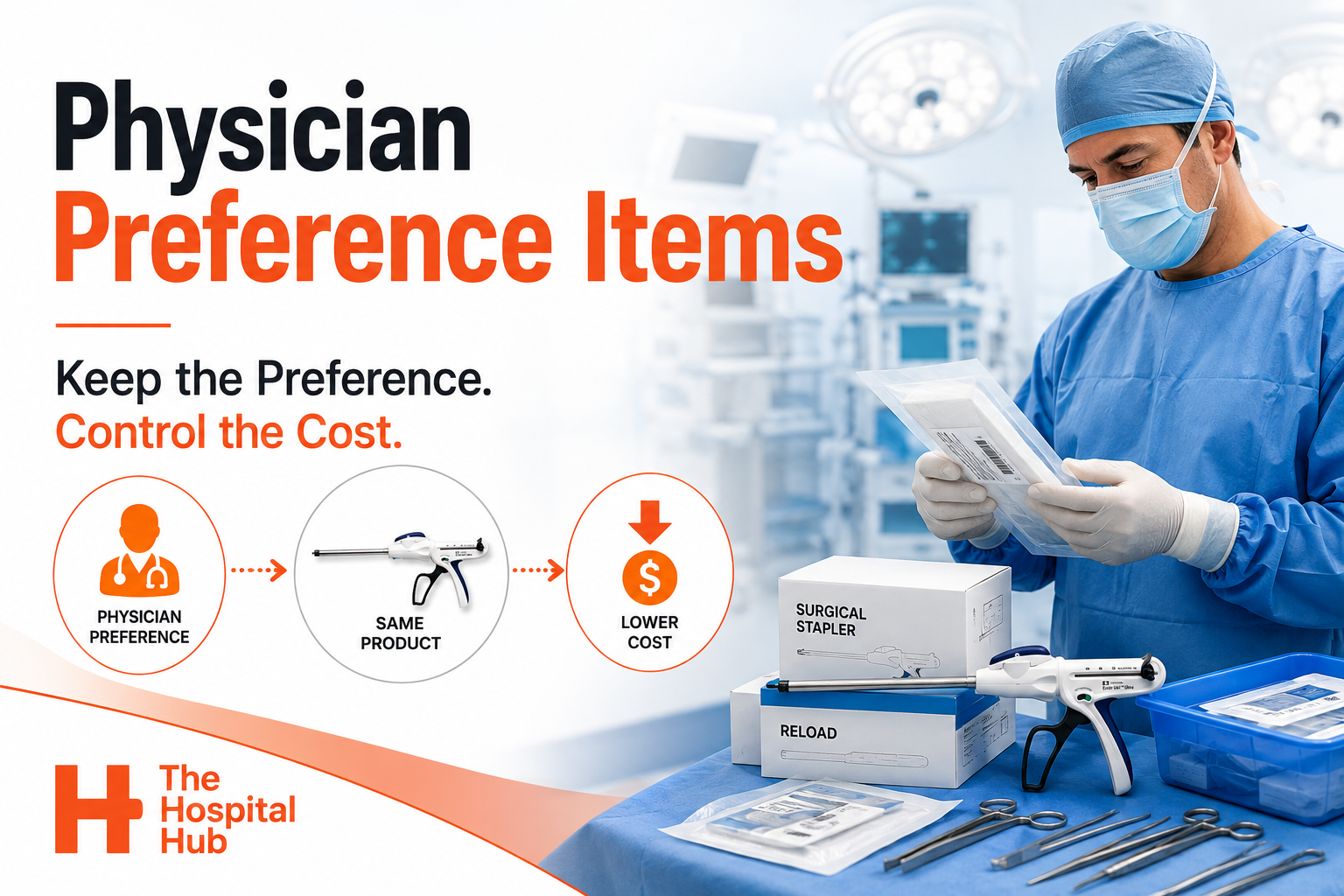
Cutting surgical supply costs shouldn’t automatically mean telling your surgeons they have to switch brands.
For hospitals and surgery centers looking to reduce surgical supply costs, brand conversions are often presented as one of the most obvious options. Switch manufacturers, negotiate a lower price, and capture the savings.
Sounds simple.
Except changing a physician-preference product can introduce new training, disrupt established OR workflows, leave valuable inventory stranded on the shelf, and sometimes even require changes to supporting equipment.
There is another option.
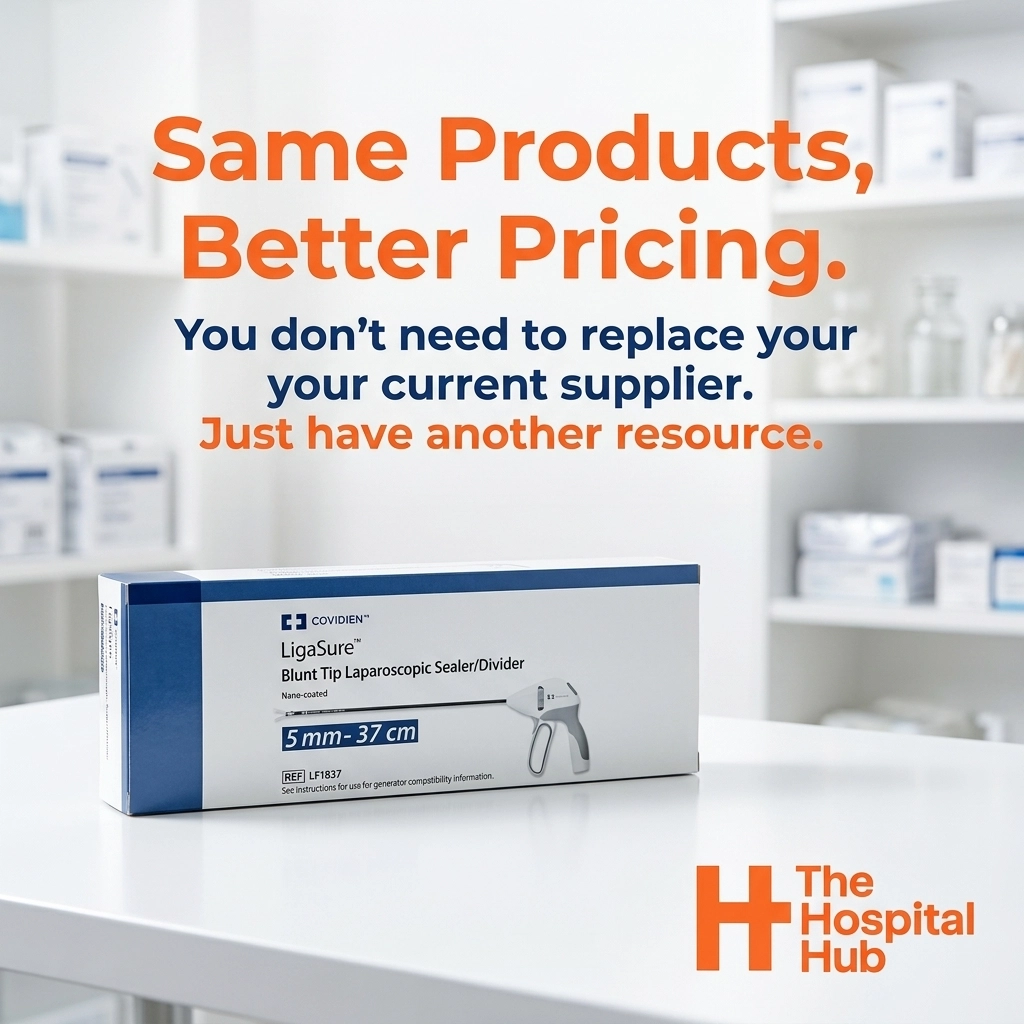
Hospitals and surgery centers can use alternative sourcing channels to purchase many of the same in-date OEM surgical supplies their teams already know and use — often at a lower cost.
At The Hospital Hub, we call that Smarter Sourcing.
Why Hospitals Look to Brand Conversions for Cost Savings
Surgical supplies represent a significant and ongoing expense for hospitals and ambulatory surgery centers. When leadership looks for opportunities to reduce supply spend, physician-preference items are naturally part of the conversation.
A brand conversion can look attractive on paper.
If Manufacturer B offers a lower contract price than Manufacturer A, switching appears to create immediate savings.
But the purchase price of the product is only one part of the equation.
For products used every day in the operating room, changing manufacturers can affect surgeons, clinical staff, inventory, equipment and established workflows.
That doesn’t mean brand conversions never make sense. Sometimes they absolutely do.
But facilities shouldn’t have to switch products just to access better pricing.
The Hidden Costs of Switching Surgical Supply Brands
Before evaluating a brand conversion based solely on unit price, it is worth looking at what else may change.
Physician Preference and Clinical Consistency
Surgeons develop preferences for particular surgical devices for a reason.
They become familiar with how a stapler fires, how an energy device handles, how an instrument feels and how a particular product performs during a procedure.
Those preferences can become an important part of an efficient and predictable surgical workflow.
Changing a physician-preference item simply because another brand has a lower price can create resistance and require clinical evaluation before the savings ever materialize.
Staff Training and Workflow Disruption
A product conversion rarely affects only the surgeon.
OR nurses, surgical technicians, sterile processing teams, materials management and other staff may all need to learn new products, packaging, item numbers and processes.
Even seemingly small changes can create additional work when they are multiplied across an entire surgical department.
Stranded Surgical Inventory
Then there is the inventory already sitting on the shelf.
A facility may have thousands of dollars in perfectly usable surgical supplies when a contract changes, a physician leaves or the organization standardizes to another manufacturer.
Those supplies don’t suddenly lose their value.
But if the facility no longer uses them, they can sit in storage until they eventually expire.
That’s not a purchasing savings.
That’s money sitting on a shelf.
Equipment and Generator Compatibility
Some surgical disposables work with specific generators, consoles or other capital equipment.
Switching the disposable product may therefore involve more than changing a box on the shelf. Facilities need to consider whether the new product requires different supporting equipment, accessories, training or maintenance.
A lower unit price isn’t necessarily a lower total cost.
How Hospitals Can Reduce Surgical Supply Costs Without a Brand Conversion
This is where alternative sourcing can create another option.
Instead of replacing your contracted manufacturers or changing the products your physicians prefer, an alternative surgical supply source can supplement your existing purchasing strategy. This type of multi-lever approach to cost reduction aligns with a broader shift in healthcare supply chain strategy — looking beyond a single cost-cutting tactic to identify savings while balancing cost, quality, and operational needs.
The idea is simple:
Keep your contracts. Keep your preferred products. Add another place to check.
If your facility normally purchases a particular Ethicon, Medtronic, Covidien, Stryker or other OEM surgical product, there may be opportunities to purchase that exact product through the secondary market at a lower price.
No mandatory conversion.
No long-term purchasing commitment.
No need to change a product simply because you’re trying to reduce costs.
If the product and pricing make sense, you buy it.
If they don’t, you don’t.
That’s why we think of alternative sourcing as another tool in the supply chain toolbox — not a replacement for your existing purchasing strategy.
What Is Secondary-Market Surgical Supply Sourcing?
The secondary surgical supply market helps redistribute legitimate OEM surgical inventory that is no longer needed by its original owner.
Hospitals and surgery centers end up with excess inventory for all kinds of reasons:
-
- Changes in physician preference
-
- Manufacturer or vendor conversions
-
- Overstocking or excess safety stock
-
- Changes in procedure volume
In many cases, those products are still unused, in date and in their original unopened manufacturer packaging.
Instead of allowing usable inventory to expire on one facility’s shelf, companies like The Hospital Hub purchase eligible surplus inventory and make those products available to other healthcare facilities.
One hospital has a product it no longer needs.
Another hospital is still using that exact product.
Connecting the two creates an opportunity to reduce waste and reduce surgical supply costs.
That’s the basic idea behind Smarter Sourcing.
Can Hospitals Buy the Same OEM Surgical Supplies for Less?
In many cases, yes.
The key distinction is that alternative sourcing does not necessarily mean switching to an alternative product.
A facility using a specific OEM product can search for that same manufacturer and product code through an additional sourcing channel.
For example, facilities may be able to find savings on physician-preference products and other surgical supplies from manufacturers such as Ethicon, Medtronic/Covidien, Stryker, Arthrex and other major OEM brands.
This can include categories such as:
-
- Surgical staplers and reloads
-
- Other physician-preference surgical supplies
Availability varies because secondary-market inventory is constantly changing.
That’s actually why having an additional sourcing resource can be valuable.
Your primary distributor or manufacturer contract doesn’t have to disappear. You’re simply creating another place to check when you need a particular product or want to see whether a savings opportunity exists.
Where Does Surplus Surgical Inventory Come From?
One of the most common questions about secondary-market surgical supplies is simple:
Why would a hospital have perfectly good products it doesn’t need?
If you work in hospital supply chain, you probably already know the answer.
It happens all the time.
A surgeon leaves and their preferred products remain behind.
A facility converts vendors and still has inventory from the previous manufacturer.
A service line changes.
Procedure volume drops.
Purchasing requirements create more inventory than the facility ultimately uses.
Safety stock accumulates.
A product is standardized out of the system.
None of those situations necessarily mean there is anything wrong with the product.
It simply means the facility no longer needs it.
Without another outlet, that inventory can sit until expiration and ultimately become waste.
Reduce Costs on Both Sides of Your Surgical Inventory
Purchasing surgical supplies for less is only half of the opportunity.
Hospitals can also improve their overall supply spend by recovering value from inventory they already own but no longer use.
Think of it as looking at both sides of the shelf.
On one side: your facility is purchasing surgical supplies it needs.
On the other: it may have thousands of dollars in surgical inventory it doesn’t need anymore.
The Hospital Hub works with facilities on both.
Through our Smarter Sourcing program, hospitals and surgery centers can purchase in-date OEM surgical supplies when we have an opportunity to offer meaningful savings.
Through our Surplus Buying Program, facilities can sell eligible surgical supplies and equipment they no longer need.
That means a materials management team can potentially reduce what it spends on incoming inventory while recovering value from outgoing inventory.
And there is an added benefit: usable surgical products have a better chance of being used instead of expiring on a shelf or becoming waste.
What to Look for in an Alternative Surgical Supply Source
Adding another sourcing option should make your job easier, not create another headache.
When evaluating an alternative supplier, hospitals and surgery centers should understand exactly what they are purchasing and how the supplier handles its inventory.
At The Hospital Hub, the surgical supplies we sell are:
-
- In original, unopened manufacturer packaging
Facilities should also look for a supplier that makes it easy to evaluate opportunities without requiring unnecessary commitments.
You shouldn’t have to move all of your purchasing to find savings on one product.
Sometimes the smartest purchasing decision is simply knowing where else to look.
A Simple Way to Start Reducing Surgical Supply Costs
You don’t need to overhaul your entire purchasing strategy to explore alternative sourcing.
Start with the products you’re already buying.
Send The Hospital Hub a list of the surgical supplies your facility uses regularly, particularly higher-cost physician-preference items.
We’ll compare that list against available inventory and identify where we may be able to help.
You can review the pricing against what you’re currently paying and decide whether the opportunity makes sense.
Worst case?
We don’t have the product or can’t beat your current pricing.
Best case?
You find another way to reduce surgical supply costs without changing a single product in the OR.
We like those odds.
Frequently Asked Questions About Reducing Surgical Supply Costs
Do hospitals have to switch surgical supply brands to save money?
No. Brand conversions are one strategy for reducing supply costs, but they are not the only option. Hospitals and surgery centers can also explore alternative sourcing channels for the same OEM products they already use.
What are OEM surgical supplies?
OEM stands for Original Equipment Manufacturer. An OEM surgical supply is manufactured by the original manufacturer rather than being a substitute or imitation product.
Are secondary-market surgical supplies used?
The surgical supplies sold by The Hospital Hub are unused, in-date OEM products in their original unopened manufacturer packaging.
Why are secondary-market surgical supplies sometimes less expensive?
Surplus inventory can enter the secondary market when healthcare facilities experience physician changes, vendor conversions, contract changes, overstock, service-line changes or other situations that leave them with products they no longer need. Alternative sourcing creates an opportunity for that inventory to be redistributed rather than wasted.
Can a hospital keep its existing contracts and still use an alternative supplier?
Yes. The Hospital Hub is designed to be an additional sourcing resource. Facilities can maintain their existing manufacturer, distributor and GPO relationships while checking alternative availability and pricing when it makes sense.
Can hospitals sell surgical supplies they no longer use?
Yes. Eligible in-date surplus surgical supplies and certain surgical equipment may have resale value. The Hospital Hub purchases surplus directly from hospitals, surgery centers and other qualified healthcare organizations through our Surplus Buying Program.
What types of surgical supplies can hospitals source through The Hospital Hub?
Inventory changes regularly but may include surgical staplers and reloads, energy devices, sutures, mesh, orthopedic products, vascular products, endoscopic supplies and other physician-preference items from major OEM manufacturers.
Reduce Surgical Supply Costs Without Disrupting the OR
Reducing costs doesn’t always require changing what works.
For hospitals and surgery centers trying to control surgical supply spend, the first question doesn’t have to be:
“What can we switch to?”
Sometimes a better question is:
“Can we buy what we’re already using for less?”
Alternative sourcing gives facilities another way to answer that question.
Keep the products your physicians trust. Maintain the purchasing relationships that work for your organization. Recover value from surplus inventory you no longer need.
And when there is an opportunity to purchase the same OEM surgical supplies at a better price, take it.
That’s Smarter Sourcing.
Have a list of products you’re currently purchasing? Send it to The Hospital Hub and let us see where we can find savings.