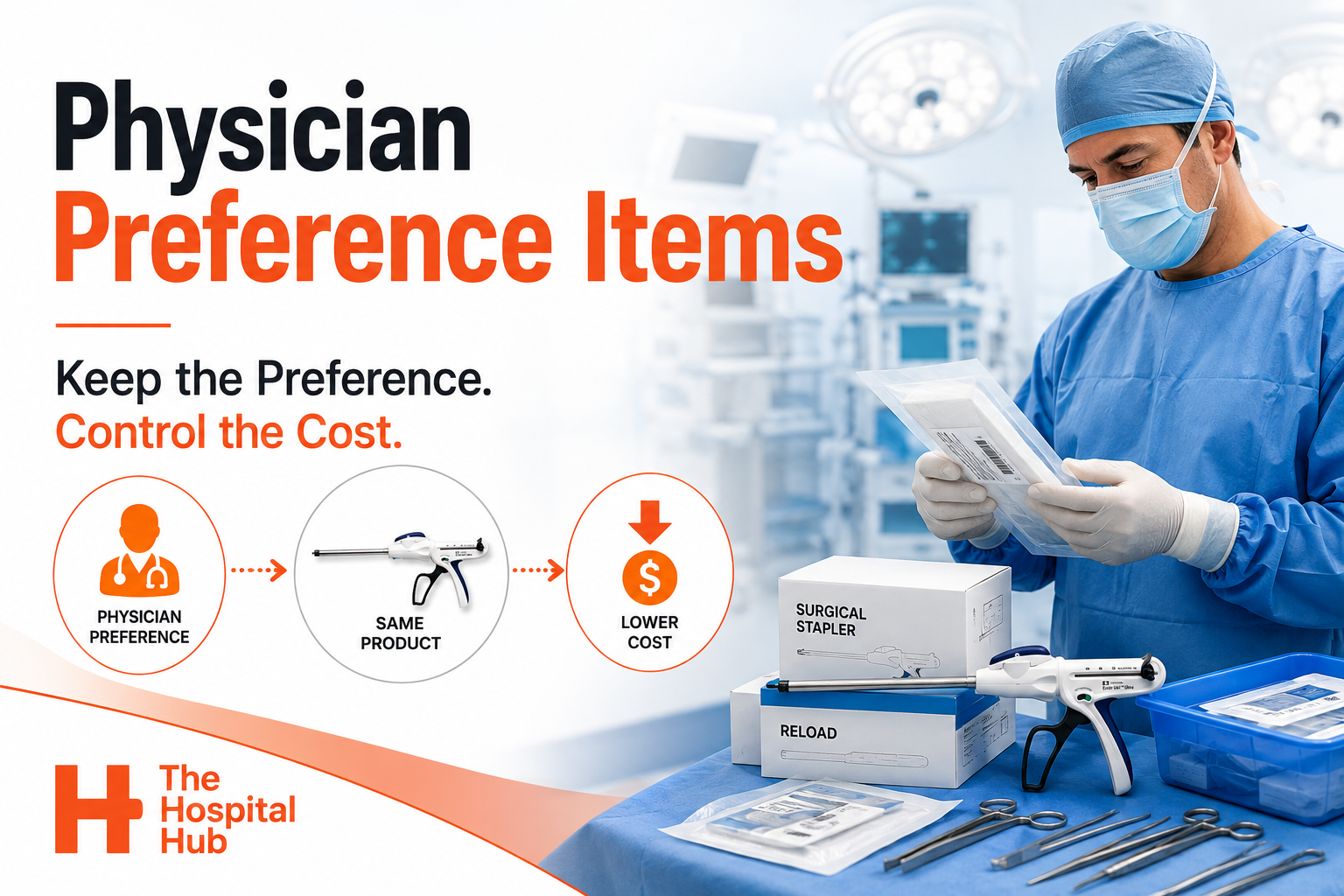
Physician preference items (PPI) can be one of the most challenging areas of surgical supply spend to control.
Surgeons often rely on specific brands, devices, and surgical supplies based on years of training, familiarity, and clinical experience. Those preferences matter in the operating room—but they can also create challenges for hospital supply chain teams trying to control costs.
And the financial impact can be significant. Published research has estimated that physician preference items may represent roughly 40% to 60% of a hospital's total supply expenditures.
The solution isn't necessarily asking surgeons to change what they use.
Hospitals and surgery centers can reduce PPI costs by improving visibility, managing inventory more strategically, and finding better ways to source the same OEM surgical supplies physicians already prefer.
Here are five ways healthcare organizations can reduce physician preference item costs without creating unnecessary disruption in the OR.
What Are Physician Preference Items (PPI)?
Physician preference items are medical devices, surgical supplies, implants, instruments, and other products that physicians prefer to use based on their individual training and clinical experience.
In the operating room, these preferences may include products such as:
- Surgical staplers and reloads
- Energy devices
- Orthopedic implants
- Arthroscopy products
- Surgical instruments
- Wound closure products
- Specialty procedural supplies
PPI can become particularly challenging for supply chain teams when a physician's preferred product falls outside the hospital's primary vendor contracts.
The hospital may still need to purchase the product, but without the pricing advantages associated with its contracted vendors.
That creates a difficult balance between clinical preference and surgical supply cost control.
For additional industry resources on physician preference items, value analysis, cost management and procurement, AHRMM maintains a dedicated Physician Preference Items resource center.
Why Physician Preference Items Can Increase Surgical Supply Costs
Traditional supply chain strategies often rely on standardization and purchasing volume to negotiate better pricing.
Physician preference items don't always fit neatly into that model.
A hospital may have a contract with one manufacturer while a surgeon prefers an equivalent product from another OEM. Completely eliminating that preference may not be practical—or desirable.
Instead, the opportunity is to look beyond simply asking:
"Can we get the surgeon to use something else?"
A better question may be:
"Can we reduce what we're paying for the product the surgeon already wants?"
That distinction opens the door to several additional cost-saving strategies.
5 Ways to Reduce Physician Preference Item Costs
1. Give Physicians Visibility Into PPI Costs
One of the simplest ways to improve PPI management is to make cost information visible.
Surgeons may know exactly which product they prefer but have very little visibility into the price differences between comparable products or the effect those choices have on procedure costs.
Providing physicians with information such as:
- Product cost
- Cost per procedure
- Utilization
- Comparable products
- Contract status
- Cost differences between physicians or procedures
can make conversations about supply costs much more productive.
The objective isn't to criticize individual purchasing decisions. It's to give clinicians and supply chain teams the same information so they can make decisions together.
2. Use PPI Data to Identify Cost-Saving Opportunities
Hospitals already generate enormous amounts of purchasing and utilization data. The challenge is turning that information into actionable opportunities.
Start by looking for variability.
Are surgeons performing the same procedure using significantly different supplies?
Are certain physicians frequently requesting off-contract products?
Are there high-cost items being purchased in relatively small quantities?
Are some products consistently being purchased outside normal contracting channels?
Those outliers can help supply chain teams determine where a deeper review could produce meaningful savings.
PPI management doesn't necessarily require eliminating every variation. The goal is identifying which variations actually matter financially.
3. Rethink How You Source Off-Contract Surgical Supplies
This is where hospitals may have an opportunity that is frequently overlooked.
If a physician prefers a specific OEM product, the choice doesn't always have to be:
Pay the traditional price or change the product.
There may be another option.
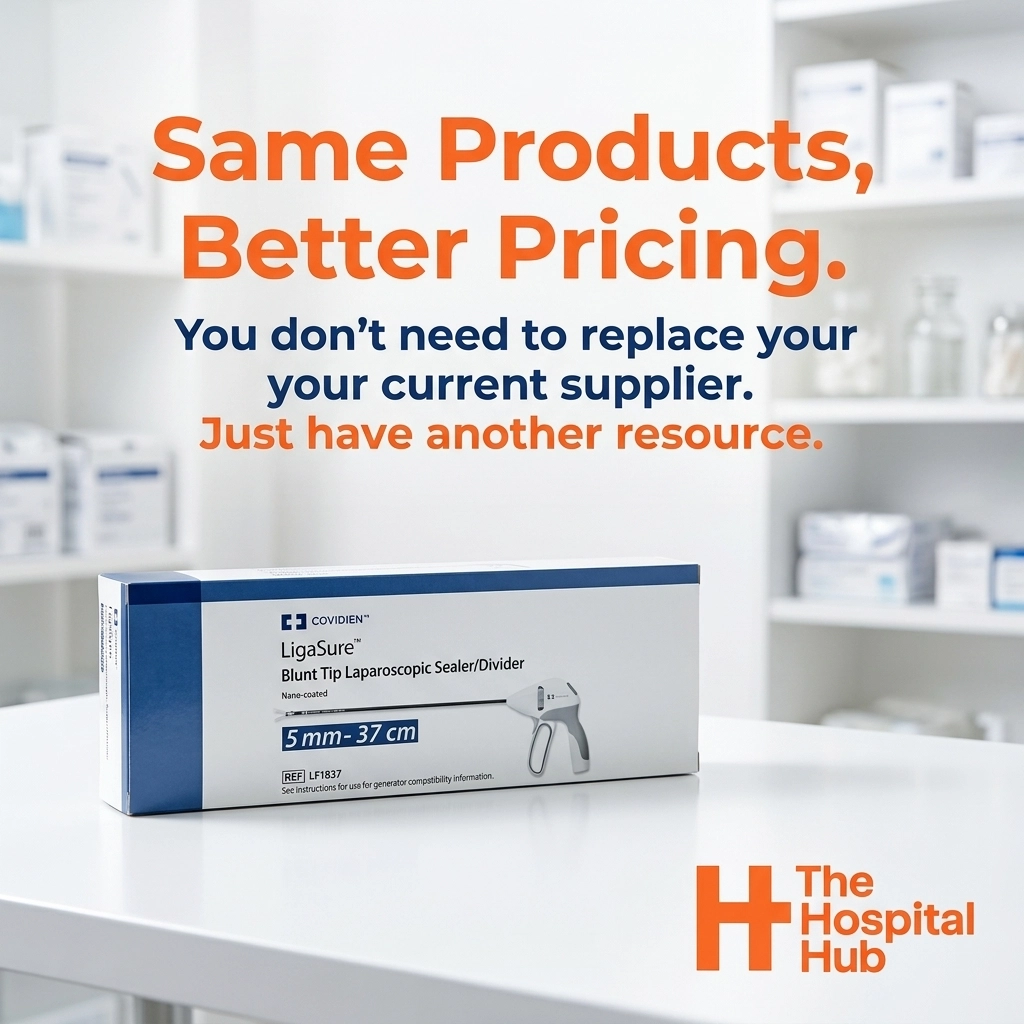
Hospitals and surgery centers can supplement their traditional purchasing channels by sourcing the same in-date OEM surgical supplies through alternative suppliers when appropriate.
This can be particularly useful for physician preference items that are purchased outside a facility's primary contracts.
Alternative sourcing doesn't have to replace existing contracts or vendor relationships. It can be used selectively as an additional purchasing option when contract pricing isn't available, when a surgeon prefers an off-contract product, or when another source can provide the same OEM item more cost-effectively.
Instead of asking a surgeon to change products, the supply chain team may be able to reduce the acquisition cost of the product already being requested.
The product doesn't change. The sourcing strategy does.
At The Hospital Hub, this is one of the ways we help healthcare facilities reduce surgical supply costs. We source in-date OEM surgical supplies from major manufacturers, giving hospitals and surgery centers an additional purchasing option when it makes financial sense.
It's not about replacing existing contracts or vendor relationships. It's about having another resource available when traditional pricing isn't the best option.
4. Recover Value From Unused Physician Preference Items
Reducing PPI costs isn't only about what a hospital buys.
It's also about what happens to products the hospital already purchased.
Physician preference items can quickly become surplus inventory after:
- A physician leaves the organization
- A surgeon changes product preferences
- A vendor conversion occurs
- A procedure or service line changes
- Inventory is over-ordered
- Products are replaced with newer models
- Contracting decisions change
Those products may still be unused and valuable, but without a process for identifying and moving them, they can remain in storage until they expire.
Hospitals can reduce this loss by regularly reviewing surgical inventory and implementing a process to sell surplus surgical supplies that are no longer needed.
Recovering value from unused inventory turns an eventual write-off into capital that can be redirected toward products the facility is actually using.
It also helps reduce unnecessary healthcare waste.
5. Build PPI Management Into Your Supply Chain Strategy
PPI management works best when it isn't treated as a one-time cost-cutting project.
Make it part of the normal supply chain process.
That can include regularly reviewing high-cost physician preference items, monitoring off-contract purchasing, evaluating utilization patterns, identifying surplus inventory, and comparing alternative sourcing opportunities.
Small savings across frequently used surgical supplies can become significant over time.
More importantly, this approach allows supply chain teams to manage costs without making every savings initiative dependent on changing physician behavior.
How to Reduce PPI Costs Without Frustrating Your Surgical Team
Controlling physician preference item costs doesn't have to mean taking products away from surgeons.
In many cases, the better strategy is to work around the preference rather than against it.
Give physicians better cost information. Identify the purchasing outliers that matter. Explore alternative sourcing for the same OEM products. Recover value from inventory that is no longer being used. And make PPI management an ongoing part of your surgical supply chain strategy.
The fastest way to reduce PPI spend isn't always changing what surgeons use.
Sometimes it's simply finding a better way to buy it.
Looking for Another Way to Reduce Surgical Supply Costs?
If your facility purchases physician preference items or other surgical supplies outside of your primary contracts, The Hospital Hub can serve as an additional sourcing resource.
We provide hospitals and surgery centers with access to in-date OEM surgical supplies from leading manufacturers—without requiring you to replace your existing contracts or change the products your physicians already use.
You can also send us a list of surplus surgical supplies your facility no longer needs. We'll review the inventory, provide pricing, and coordinate the shipping or pickup.
Same OEM products. More purchasing options. Less unnecessary waste.